

Part II: The Truth About Marketing
(or Trust is the Currency)
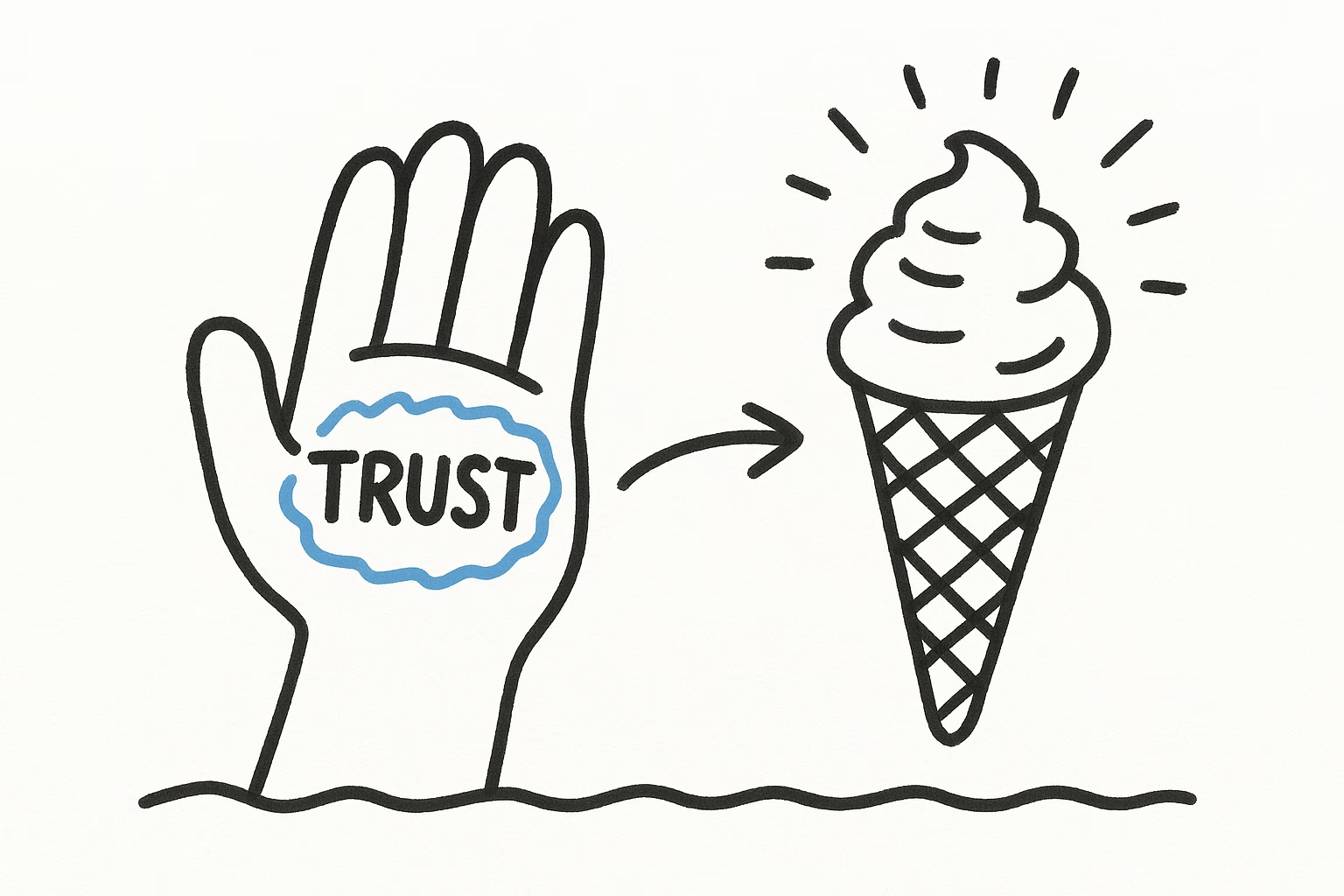
Image created by the author using ChatGPT
People buy because they trust you.
It wasn’t a single aha moment that drove this truth home for me.
It was the slow realization that the way we do business offline and the way we’re taught to do business online are worlds apart.
Think about it... offline, everything is built on trust... face-to-face conversations, a sense of relationship, the human cues that make buying feel natural.
Online, those cues are missing. Instead of filling the gap, opt-in funnels widen it.
They substitute pressure for connection. They rely on sequences and scripts that make buyers more cynical, not more trusting.
That’s why email open rates are so low.
That’s why online audiences carry so much skepticism.
The entire model teaches pressure because, unlike a real funnel, there is no gravity pulling buyers down. To make up for that absence, marketers push. They push with countdown timers, endless emails sequences, and tactics designed to simulate momentum.
Every push erodes trust further.
There's only one thing to understand:
Trust is the real currency.
Trust is what makes buying faster, easier, and more natural. Gated lead magnets don't. Hacks don't. Artificial pressure doesn't.
Trust does.
The experience paradigm

Nothing builds trust faster than experience.
That’s why ice cream shops hand out samples. A taste sells better than a pitch.
It’s human nature.
Let someone try it, and the decision becomes gut-level, not rational.
We already see this everywhere offline.
Walk into a supermarket: people try a brand they’ve never seen before and put it in their cart.
At Costco, they taste something unfamiliar and buy it on the spot.
At a farmer’s market, they discover a product they’ve never encountered, resonate with it, and take it home.
Buying without surrendering your email address first is routine in the world of atoms. It’s how humans make decisions every day.
It’s not limited to food.
Bookstores are filled with packaged knowledge. People wander in, pick up books they’ve never read, flip through a few pages, glance at a cover, or recognize an author’s name and they buy the book.

Can you see how simple this is?
This is the essence of the Experience Paradigm:
Create an environment of trust and let people experience what you offer.
This means no contrived tactics.
Get rid of your pop-ups claiming “someone just bought” or walls of testimonials plastered like armor. Those are pressure tools dressed up as proof, and buyers can feel the manipulation.
You can't force real trust. You can't build trust by pressuring people down a "funnel."
Trust comes from space, comfort, and letting people explore freely and decide on their own terms. You build trust by creating a space where they feel safe, respected, and curious enough to try.
That’s when the product sells itself.
A story of trust
Just last week, I took my son to look at a used car. It's going to be his first one.
We drove out to Buckingham, a small town near Gatineau, to meet an unassuming man selling it from his driveway.
It wasn't a dealership. There wasn't going to be any contract between us. There'll be no tight legal safety net if things went wrong.
He greeted us humbly, showed us the car, rode along on the test drive, answered our questions.
He was simply… trustworthy. Human.
My son bought the car on the spot, without an inspection or third-party validation.
Just trust.
That’s how transactions actually happen.
It’s not paperwork, pressure, or funnels that close the deal. It’s trust.
If trust can move someone to buy a car, with all the risk that entails, it can certainly move someone to buy your product or service.
This is the power of this paradigm: experience plus trust makes buying inevitable.
Go on to Part III: The Email Myth →